

Multi-age classrooms can match or exceed traditional schools on student outcomes, especially in social and emotional growth—but only when teachers have curricula and training built specifically for the model. In the Republic of the Marshall Islands (RMI), the Department of Education and Pacific East CC developed exactly that: a locally centered curriculum and training program for teachers working in multi-age classrooms across the outer atolls, where a school may serve as few as 10 to 15 students.
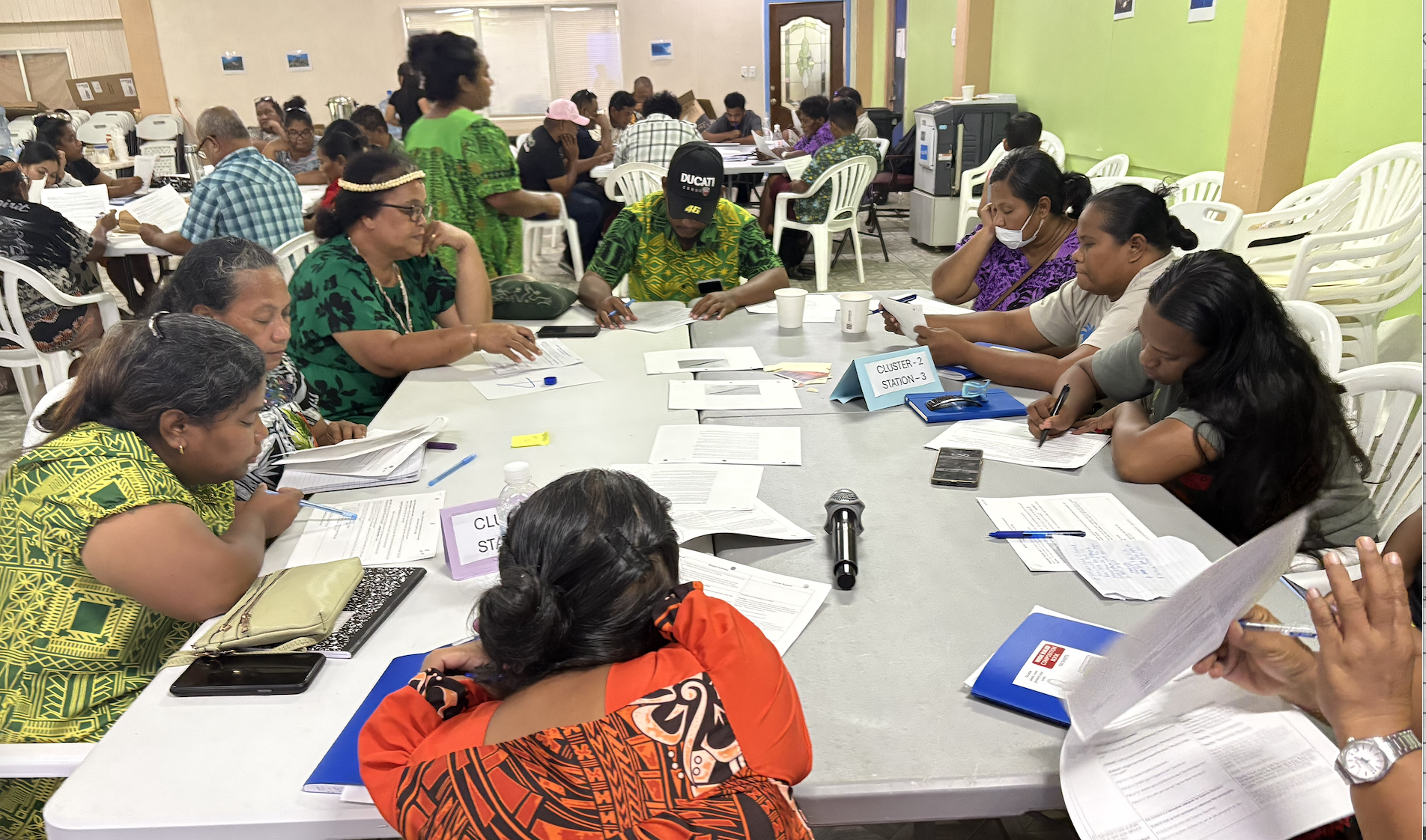
In July, more than 140 teachers gathered for a multi-day training to learn that piloted instructional philosophy, its methods, and lesson plans with two cohorts. So what did we learn? This post looks at the specifics of how the training works and the feedback of RMI educator participants.
As background, a multi-age classroom is one that puts students of different ages under one teacher and groups them by skill rather than grade. When supported well, the model produces strong academic outcomes, social-emotional growth for younger and older students alike, and the flexibility to regroup and adjust instruction as students move through school.
The model works because the unit of instruction is the child, not the grade level. Teachers chart growth over time and shift instruction to meet it. Three principles anchored the RMI training: Every child learns at their own pace and in their own time; older students teach the younger while the younger inspire the older; and every task shares one theme that makes the work relevant, even as the tasks themselves differ by learner. In the RMI, that theme is place—what participants came to call the “first curriculum.”
To develop an RMI-specific curriculum to be taught during the trainings, RMI’s Ministry of Education and the Pacific East CC supported local curriculum writers in developing the content through a series of workshops held earlier in 2026. These pilot lessons paired learning to place, highlighting the environment and local lore to make the curriculum both relevant and applicable to daily life on the atolls. This tactic allows local concepts like the reef, canoe house, and wāto (outdoor area around a house) to become classrooms just as the teacher becomes a navigator instead of lecturer.
“I was impressed by the wide range of activities,” one participant wrote, “especially the creative use of Marshallese materials.”
The week-long training offered both the curriculum and research-based teaching strategies such as Pair Shair, Walk and Talk, Four Corners, and Provocation/Hook. Teachers were provided tangible strategies in a series of short modules to move students from learning to attaining their individual goals. These modules, such as “Our Ocean, Our Classroom,” offered instructional lesson plans that included methods for contextualizing learning and differentiating instruction for students at all levels of experience.
For example, in looking at local food chains, one module focused on the story of The Hermit Crab and the Needlefish. The story describes the hubris of the needlefish, who is tricked to believe he is being outpaced by a hermit crab working together with its friends and family—ultimately showing the power of working together. The training uses this story to ask participants to work together in groups of writers, drawers, and paper chain builders to identify science observations and cultural knowledge while tracing the flow of energy from producers, consumers, and decomposers.
This type of instruction lends itself to multi-age teaching by helping teachers learn to group students by skill, aptitude, and need. Ideally, students who are excelling in one area will help those who have not yet mastered the task, while also drawing on the local environment and lore to solidify scientific learning.
As teachers completed the pilot training, many expressed gratitude for the strategies they learned; many wished the training had been two weeks instead of one, and others hoped for further support as instructional need increasingly moves toward multi-age classrooms. The Pacific East plans to deliver this support. Even as teachers were asked to provide feedback on the training, they were also given methods to track and assess their own progress—and that of their students—in using the trainings’ lessons. Ultimately, that feedback will lead to further improvements both in the trainings offered to teachers and the lesson plans provided to students.
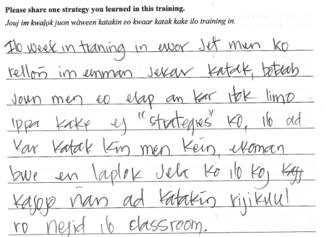
While some teachers still voiced trepidation about the future of instruction in the rural atolls, nearly all said the lesson plans and locally focused curriculum strengthened their ability to teach multi-age classrooms and gave them a clear map for charting their students’ futures. As one teacher stated in a follow-up survey, “The most valuable aspect of this week’s training was learning a range of effective teaching strategies that will enhance my instructional practice and improve student learning.”
Biram Stege, former RMI education secretary and a member of Pacific East CC, saw a similar response:
“After the Multi-age Workshop, many of the teachers commented that they could not wait to apply the teaching strategies and techniques that they learned during the workshop. Many wanted to go back immediately and share these learned strategies. I think what was wonderful was that the workshop taught teachers real, locally practical ways to teach and that this style of teaching keeps students engaged and involved in their own learning progress.”